
How Arrest Warrants Work in Dearborn County
An arrest warrant is judicial process that lets officers take someone into custody. Indiana demands a judicial decision resting on probable cause, supported by oath or affirmation. Someone authorized to apply lays out the facts. Then a judge or magistrate weighs whether the standard is met. If it is, the court signs an order naming the person, the alleged offense, and the reach of the arrest authority.
Dearborn Circuit Court, Superior Court I, Superior Court II, and Lawrenceburg City Court are the active trial-court venues for Dearborn County cases. Which one handles a matter turns on the charge and the case itself. The Clerk records and routes filings. Service then falls to the Dearborn County Sheriff, municipal police, Indiana State Police, or federal officers where applicable. Prosecutors or officers can request a warrant, but the judicial probable-cause decision stays with the court.
Dearborn County Arrest Warrant Probable Cause
The core framework sits in IC 35-33-5-1 and IC 35-33-5-2, which you can read in Indiana Code Title 35. That edition is from 2021, so the current code controls if the text has changed. In plain terms, probable cause means facts strong enough for a judge to authorize the requested warrant. A public docket summary does not replace the signed court record.
The affidavit must particularly describe the person to be arrested, name the alleged offense, and lay out supporting facts. Indiana law also covers how hearsay gets backing through credibility or corroboration. Some affidavits and investigative records may be sealed or restricted. That blocks access, but it does not mean no Dearborn County warrant exists.
Key distinction: The judge authorizes arrest; officers execute the warrant; the issuing court controls later recall, quash, or hearing orders.
Arrest Warrants: What They Contain
A Dearborn County arrest warrant record can carry real detail: the issuing court, the named person, the alleged offense, the date it issued, and any bond or service directions written into the order. MyCase sometimes shows just a docket entry rather than the warrant itself. No official sample or warrant-number format is published for Dearborn County, so treat any local warrant number you come across with caution. A court cause number such as 15D01-CR-00000 is only an illustrative court identifier, not a real case.
| Named person | The person described by the order; confirm identity and do not rely on a shared name. |
|---|---|
| Issuing court | The Dearborn trial court that controls the judicial order and next proceeding. |
| Alleged offense | The charge or statutory basis, which is not a conviction. |
| Issue date | The date the court authorized the warrant, subject to later docket events. |
| Probable-cause basis | The sworn facts reviewed by the judge, which may not all be public. |
| Bond or hold terms | Case-specific directions that must be checked against the current order. |
Read past the issuance date, too. Later events in Dearborn County, like service, an initial hearing, a recall, a second warrant, or dismissal, can change what that first docket entry means for you now.
Dearborn County Arrest Warrant Court Search
The Indiana MyCase portal is the natural first stop for public Dearborn County cases. You can search by cause number, citation number, cross-reference number, name, or attorney. Narrow the court filter to Dearborn Circuit, Dearborn Superior I, Dearborn Superior II, or Lawrenceburg City Court, then use the status and filing-date filters to cut false matches. Common surnames can hit the result cap fast, and sounds-like matching can pull in unrelated people.
- Start with personal paperwork, a citation, hearing notice, or known cause number.
- Search the correct active Dearborn court and review the full docket timeline.
- Note the warrant, hearing, bond, service, recall, or later disposition entries.
- Call the Clerk or court with the number and ask whether the warrant remains current.
- Ask what appearance, motion, counsel, bond, or surrender instruction applies.
MyCase itself warns that it is not the official court record and may have gaps. When the venue is unclear, the Dearborn County Clerk at 165 Mary Street, (812) 537-8867, is the general court-record route. Call the clerk for the authoritative answer.
How Warrants Get Served in Dearborn County
Serving a warrant is law enforcement's job, not the court's. A Dearborn County arrest warrant may be executed by the Sheriff, municipal police, Indiana State Police, or another authorized agency, often during a traffic stop or after officers locate the named person. The Sheriff posts no separate Dearborn warrant unit, no dedicated warrant phone, and no walk-in surrender appointment system, so plan around the general channels instead. After an arrest, questions about custody, booking, the initial hearing, bond, and release all turn on the actual warrant and court order. The Sheriff's jail and bail pages are useful, but they do not certify warrant status or promise release, and a person held on another county, state supervision, or federal matter may sit under a different issuing jurisdiction entirely. Ask which court or agency placed the hold and get the case number. The Sheriff's general contact at 301 W High Street, (812) 537-3431, can route service or custody questions during posted weekday office hours; it is not a warrant hotline, and emergencies belong to 911.
Dearborn Arrest and Initial Hearing Rules
Dearborn's local rules fill in what actually happens after an arrest or a release. They set initial-hearing schedules court by court, and they state that failing to appear can revoke bail and trigger an arrest warrant in the applicable bond setting. Exact timing depends on the court, the business day, and the current rule, so read the current Dearborn local rules before counting on any schedule. For the bigger frame, Indiana Criminal Rule 2.6 sets the statewide pretrial-release standards, because release is always a court decision in Dearborn County, never something a warrant search produces.
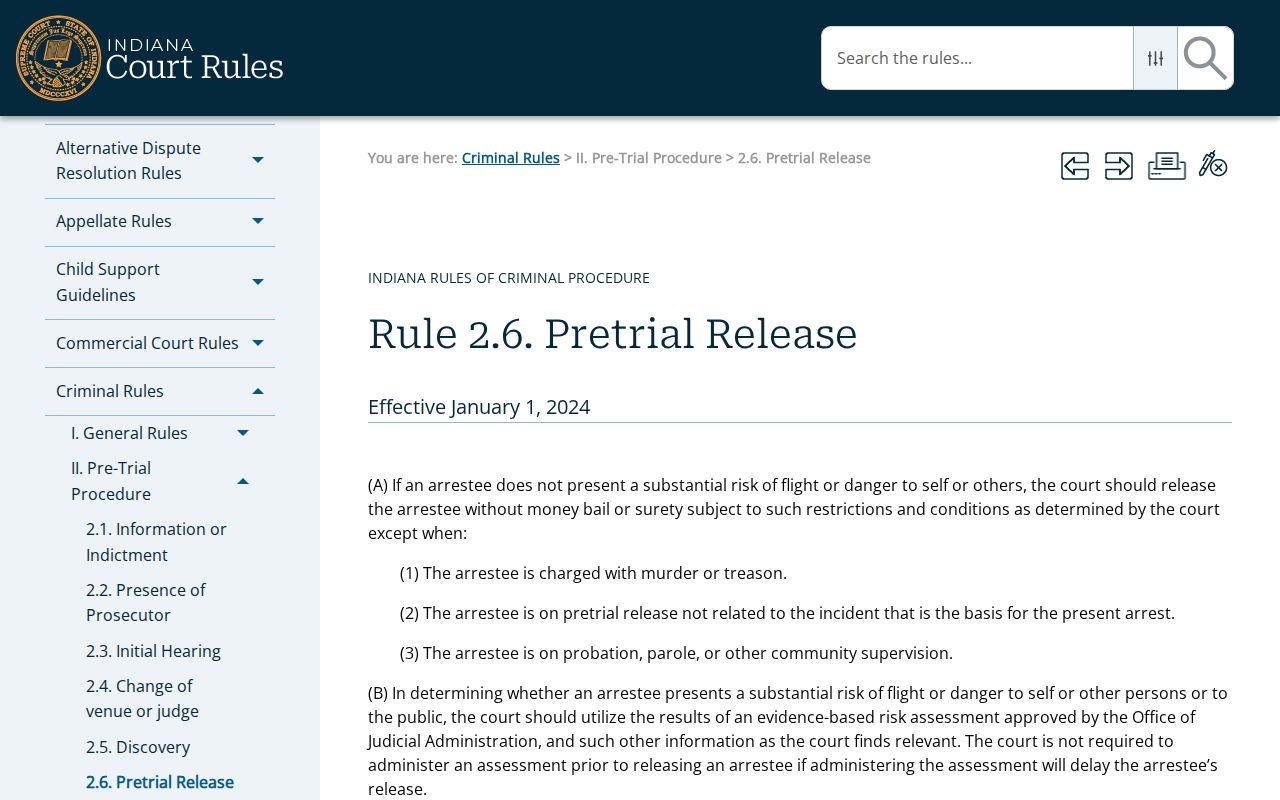
Dearborn County follows a rule that favors letting an eligible person go without money bail or a surety bond, so long as the person does not pose a substantial risk. Exclusions and an assessment still apply. That is a general rule, though. It does not recall an arrest warrant, excuse a hearing, or promise release in any specific Dearborn County case.
Arrest Warrants, Summonses, and Bench Warrants
Dearborn County courts use three different tools, and mixing them up costs time. An arrest warrant orders custody outright. A summons just tells you to show up, with no arrest attached. A bench warrant comes later, after a case exists and someone misses court or ignores a condition. Only the docket tells you which one the court actually issued.
| Feature | Arrest warrant | Summons | Bench warrant |
|---|---|---|---|
| Core direction | Authorizes arrest | Orders an appearance | Authorizes custody after a court event |
| Typical basis | Judicial probable cause or other authority | A case that proceeds by notice | Missed appearance or noncompliance |
| Issuer | Judge or magistrate | Court under applicable process | The judge handling the case |
| Public clue | Order or docket event | Summons and scheduled date | FTA, warrant, or recall entry |
| Response | Legal advice and court instructions | Appear as directed | Ask about recall, hearing, or bond |
Miss a summons date and a warrant may follow. That is not automatic. The Dearborn County bench warrant lookup covers what a missed-court order means.
Dearborn County Arrest Warrant Bond Rules
Dearborn County bond rules live in the Dearborn-Ohio County local rules, which set out a bond schedule, exceptions, and hold categories. Serious charges are one category. So are probation or supervision violations, pending matters, and fugitive cases, and other listed matters may need an initial hearing before anything moves. The schedule also separates some offense levels and residency situations, so a published amount never guarantees what applies to your Dearborn County arrest warrant. The Sheriff posts bail-bond information with cash and credit payment guidance. Those are payment and custody routes. Neither one erases a warrant online. Cash posted in the county of charge can be applied to fines, costs, restitution, judgments, public-defender reimbursement, and fees as authorized. Ask the issuing court or the Clerk for the current amount, eligibility, destination, and any required hearing. "Bond forfeiture" is a court action on a bond after its terms go unmet. Not every missed date ends there. Read the actual order, and get legal advice if the bond question is close.
Handling an Arrest Warrant in Your Name
Before anything else, confirm the person, the court, the cause number, and the current status. Then talk to an Indiana attorney or the issuing court. The right move depends on the order itself. Counsel may arrange an appearance, move the court to recall or quash, post an authorized bond, or plan a voluntary surrender. "Recall" means the court pulls the warrant back. "Quash" means the court sets it aside by judicial action, and a Dearborn County judge decides which applies.
Act carefully: Obtain legal advice and official instructions before surrender; a public search cannot guarantee timing, bond eligibility, or release.
Do not show up unannounced and expect a website result to stop an arrest. Do not evade service or interfere with officers either. Keep written proof of any hearing, recall, release, or disposition. Ask the court how its update reaches law enforcement. The Dearborn County warrant records overview sorts out the Clerk, Sheriff, and court roles.
Restricted Dearborn Arrest Warrant Records
Indiana starts from open access, and Court Rule 5 lists what stays confidential: sealed matters, juvenile information, investigative records, search-warrant material, victim details, and informant data may never reach the web. Rule 4 sets the baseline. Rule 9 offers a controlled request process, not a way around confidentiality. When MyCase shows nothing for a Dearborn County matter, request the specific public record from that court or the Clerk. Name the case number. Describe the docket entry or order with reasonable particularity. The Indiana Access to Public Records Act does not force an agency to build a list of every current arrest warrant or do legal research for you. If Dearborn County denies access, ask for the written rule or statute behind the decision. Handle whatever you obtain with care. Full birth dates, addresses, Social Security numbers, juvenile facts, victim information, and unredacted affidavits should never be republished. Warrant records exist to help someone resolve a court matter, not to shame, confront, or expose another person.